
Your privacy is not just a personal matter; it's a fundamental constitutional right. The Fourth Amendment to the United States Constitution is your shield against unreasonable searches and seizures by the government. It's a powerful tool that, when understood and utilized, can protect you from potential violations of your constitutional rights.
The Fourth Amendment says: “The right of the people to be secure in their persons, houses, papers, and effects, against unreasonable searches and seizures, shall not be violated, and no Warrants shall issue, but upon probable cause, supported by Oath or affirmation, and particularly describing the place to be searched, and the persons or things to be seized.”
In simple terms, law enforcement needs a warrant or probable cause to search you or your property. Any search or seizure that bypasses this requirement is unlawful and unconstitutional. Evidence gathered unlawfully may be barred from court under the exclusionary rule.
The Fourth Amendment isn't just a legal concept-it's a practical safeguard. Failing to respect these protections can lead to wrongful arrests, privacy violations, loss of personal property, and unfair legal processes. Understanding and asserting your Fourth Amendment rights can make a real difference in your life.
Key Takeaways
- The Fourth Amendment to the US Constitution provides a vital safeguard for individuals suspected of a crime: protection against unreasonable searches and seizures.
- It assures people the right to be safe in their persons, houses, papers, and possessions, and states that warrants for searches or seizures need probable cause, must be sworn under oath, and must specifically identify the place to be searched and the items to be seized.
- This constitutional safeguard guarantees that police cannot unjustly intrude on your privacy or seize your property without a valid reason.
- Although these protections are essential, they are not always consistently enforced, and breaches of Fourth Amendment rights happen more frequently than most people realize.
- It's important to be aware of the common examples of Fourth Amendment violations. For instance, police searching someone's home without a warrant or conducting an extensive vehicle search during a routine traffic stop without probable cause are clear violations of the law. Knowing these examples can help you recognize and respond to potential violations.
- Applying excessive force during a traffic stop to detain someone without probable cause may violate the Fourth Amendment. Similarly, wiretapping without a warrant or recording conversations without a court order can also be violations.
The Fourth Amendment does not prohibit all searches and seizures; it only prevents those deemed unreasonable by law. Despite the protections it provides, violations occur frequently. Below are some of the most common examples.
Warrantless Searches Without Probable Cause
A clear violation occurs when law enforcement searches your car or home without a valid warrant or your consent, especially if no exceptions, such as exigent circumstances, apply.
For instance, if an officer searches your vehicle or residence during a routine stop without permission or justification, or if investigators break into your home claiming evidence was at risk of destruction when it was not, this could constitute an illegal search.
Exceeding the Scope of a Lawful Search
Even when a search warrant is valid, law enforcement must operate within the scope of the warrant. For instance, if the warrant permits officers to search your home for stolen electronics, they cannot search personal documents or unrelated data on your computer. Likewise, seizing items not specifically listed in the warrant is illegal.
Using Overbroad Warrants
A warrant must clearly specify what is to be searched and seized, and it must be founded on probable cause. Violations happen when:
- The warrant is too broad, permitting searches of areas or items not connected to the investigation.
- The warrant was issued without sufficient probable cause.
- The warrant is based on false or misleading information provided by investigators.
Evidence obtained from searches conducted under invalid warrants may be deemed to have been illegally collected.
Pretextual Stops and Searches
A pretextual stop occurs when police use a minor reason, such as a traffic violation, to stop and search you or your vehicle, even though their true purpose is to investigate something else without proper legal grounds.
This practice, while common, is a violation of the Fourth Amendment if the actual reason for the stop is unrelated and there is no probable cause. In such cases, any search or evidence collected may be challenged as a violation of the Fourth Amendment.
Search Incident to Arrest Without Legal Grounds
Officers generally have the authority to search a person and their immediate surroundings following an arrest, provided they have a lawful reason for making the arrest. If the arrest is unlawful, then any subsequent search could also breach the Fourth Amendment.
Coerced or Manipulated Consent
Law enforcement officials or investigators might request your permission to conduct a search. Giving your consent means you waive your Fourth Amendment rights, allowing them to search without a warrant. However, if investigators use intimidation or deception to obtain your consent, it is regarded as "coerced consent" and may violate your Fourth Amendment rights.
Unreasonable Use of Surveillance
Surveillance methods, such as wiretapping or GPS tracking, are commonly employed in criminal investigations, but they typically require a warrant. Conducting surveillance without the necessary judicial approval can be considered a violation, particularly when advanced technologies are used to infringe on your reasonable expectation of privacy.
Why You Need a Criminal Defense Lawyer
If your Fourth Amendment rights have been violated, our California federal criminal defense attorneys can leverage these violations to strengthen your defense, as discussed below.
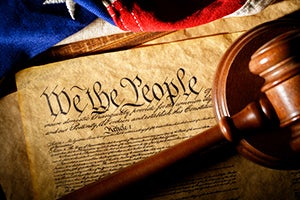
Perhaps we can file a motion to suppress evidence. If evidence was acquired through an illegal search or seizure, the attorney can claim it is inadmissible in court under the "exclusionary rule."
This rule, a key protection of the Fourth Amendment, states that evidence obtained in violation of a person's constitutional rights is generally not admissible in court, thus weakening the prosecution's case.
Challenging the validity of the warrant involves arguing that it was issued without probable cause, was excessively broad, or was founded on false information. If successful, any evidence obtained through that warrant can be excluded.
We might consider filing a motion to dismiss the charges. Sometimes, violations of the Fourth Amendment can lead to the dismissal of charges entirely. For example, if the prosecution's evidence is suppressed due to a Fourth Amendment violation, the court may be compelled to dismiss the case due to insufficient evidence.
Similarly, if a warrant is found to be invalid due to lack of probable cause or excessive breadth, any evidence obtained through that warrant can be excluded, potentially leading to the dismissal of charges. For further assistance, contact the Hedding Law Firm in Los Angeles, CA.
Related Content:


